The Story Behind the Research
How a prestigious international award, a personal connection to Germany, and a partnership between Chicago and Halle became the foundation for one of the most ambitious research projects on the economic legacy of German division.
The Max Planck–Humboldt Research Award
An award, an invitation, and one of Europe's most enduring economic puzzles.
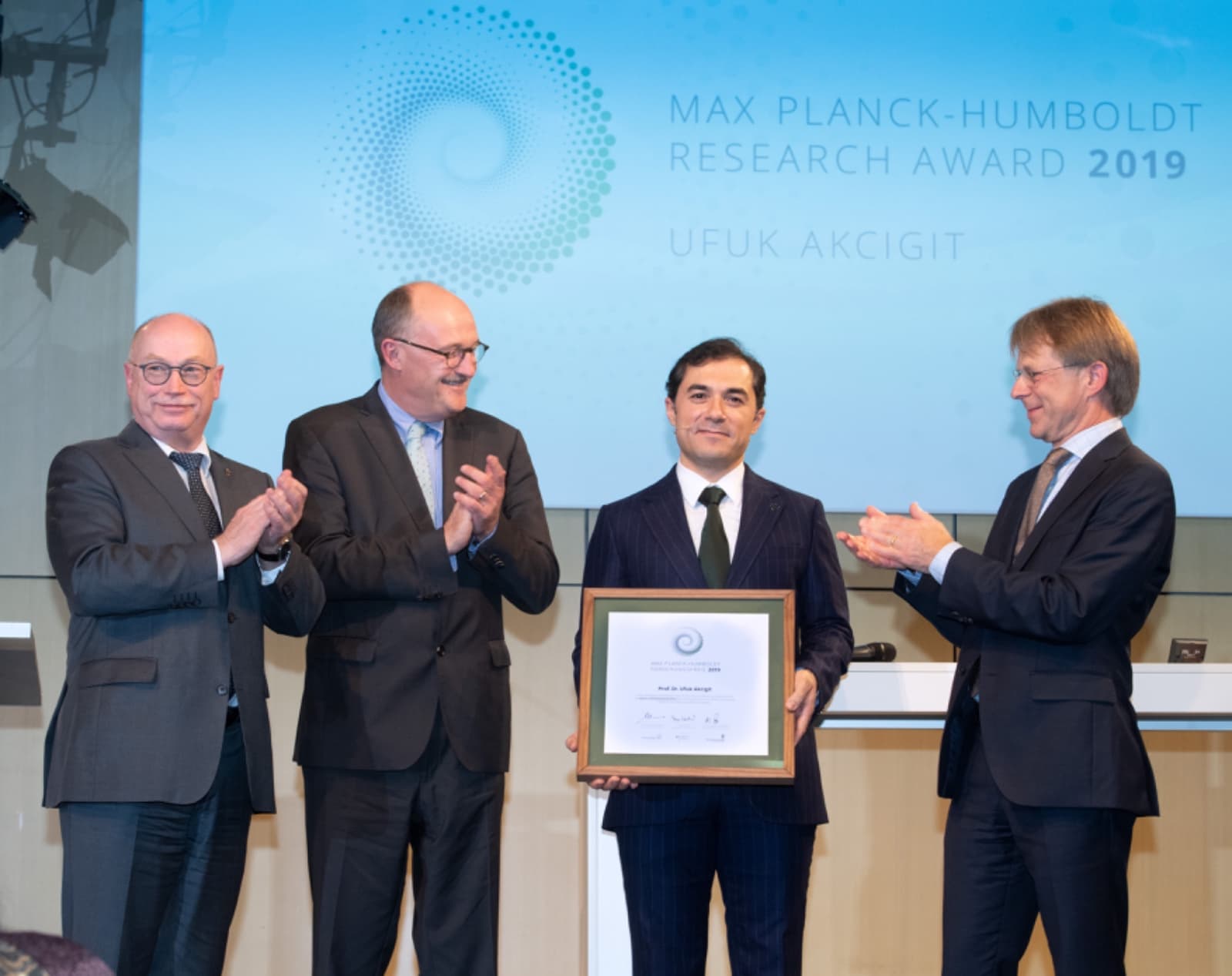
On November 5, 2019 — thirty years after the fall of the Berlin Wall — Ufuk Akcigit, Professor of Economics at the University of Chicago, was awarded the Max Planck–Humboldt Research Award in a ceremony during Berlin Science Week.
The award, jointly presented by the Max Planck Society and the Alexander von Humboldt Foundation and funded by the German Federal Ministry of Education and Research, carries €1.5 million in research funding over five years, with an additional €80,000 in personal prize money. It is one of the most prestigious research prizes in Europe, designed to attract outstanding international scientists to conduct ambitious research within Germany.
Akcigit was the first social scientist ever to receive the award, which had previously been granted only in the natural and engineering sciences. But the award was not just a recognition of past work — it was an invitation to tackle one of the most enduring economic puzzles in modern Europe: why, three decades after reunification, the gap between East and West Germany still refuses to close.
“Economies that are subject to similar conditions should converge to the same economic wellbeing in the long run. Yet the two sides of Germany have not managed to do so — despite many attempts since reunification. For me as a researcher, this is a very interesting puzzle and a unique set-up to study.”
A Personal Mission, A Scientific Question
For Akcigit, the project carried a personal dimension alongside its scientific ambition. Born in Germany to a Turkish family, he left the country at the age of five — but maintained a lifelong connection to the place of his birth.
“Germany has always been part of my life, part of my culture. I have always been interested in staying in touch with my German friends, but also learning more about the country in which I was born. The Max Planck–Humboldt Research Award gives me the opportunity to intensify my ties with Germany.”
His broader research had long focused on the drivers of innovation and technology — the forces that explain why some economies grow rapidly while others stagnate. When we talk about the performance of an economy, we typically report a single number: GDP per capita or growth. But that number emerges from the interaction of millions of people and millions of firms, every single day. To explain it, one must go to the micro level — to individual firms, workers, decisions — and then build upward to understand the macro picture.
This approach — combining micro-level data with structural economic theory and computational techniques — was precisely what Akcigit proposed to bring to the German question. The persistence of the East–West gap, even in the absence of language barriers or geographical obstacles, defied standard economic predictions. Something deeper was at work, and the only way to find it was through data.
“Before designing policies, I think it is important to do data-driven research. Let the data speak now in order to promote data-driven policy-making in the future.”
Chicago Meets Halle
Building a research family across two continents.
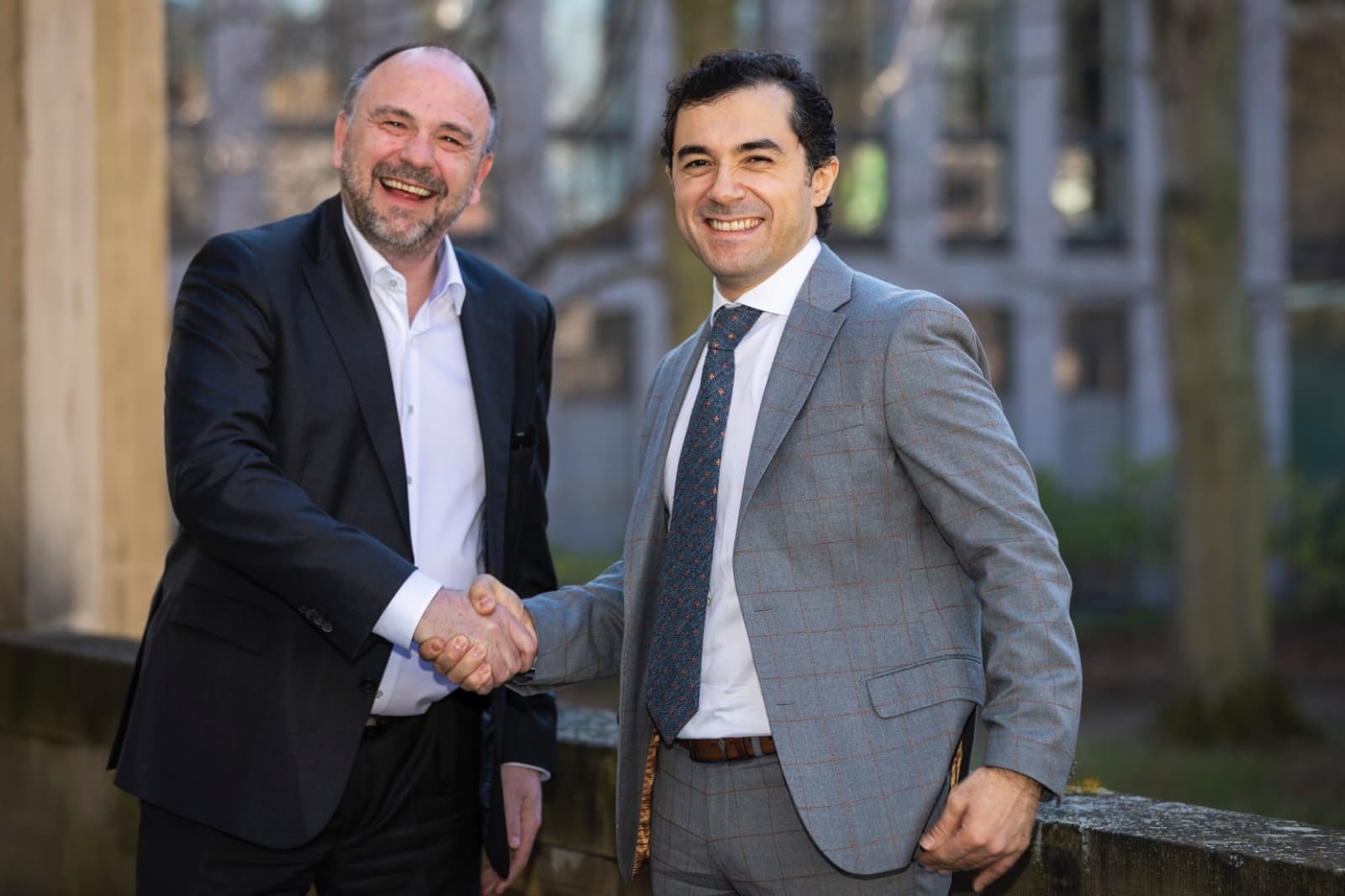
Ufuk Akcigit with the President of the Leibniz-IWH, formalizing the transatlantic collaboration.
The award enabled Akcigit to formalize a collaboration with the Halle Institute for Economic Research (IWH), a leading member of the Leibniz Association and one of Germany's foremost institutions for studying economic transformation in the East. The IWH's deep roots in research on the transition from central planning to a market economy — and its access to critical archival and administrative data — made it the natural partner for this work.
“We fit so well together because they have the right data, they have the right people that already work on similar issues. They were able to provide the optimal environment — and that's why I chose the Halle Institute.”
The IWH echoed the sentiment. The collaboration was described as a meeting of complementary strengths: Akcigit's theoretical frameworks and international perspective combined with the IWH's granular knowledge of the East German economy and its unparalleled data infrastructure — including access to the Treuhandanstalt archives, employment records from the Institute for Employment Research (IAB), and historical firm-level data from the period of unification.
Using the research grant, Akcigit built a dedicated team in Germany of five to six researchers, working alongside existing IWH staff. A parallel team operated from the University of Chicago. The two groups were designed to function as a single unit — holding weekly online conferences, sharing findings in real time, and regularly exchanging researchers between Halle and Chicago.
“I hope that we will become one very big research family.”
That vision has since become reality. The project now operates as a tightly connected network spanning two continents.
A Wider Network
The project draws on a transatlantic web of researchers, institutions, and archives — each contributing a piece of the puzzle.
Funding & Acknowledgments
Max Planck–Humboldt Research Award 2019 · Max Planck Society × Alexander von Humboldt Foundation · funded by the German Federal Ministry of Education and Research (BMBF).
The researchers gratefully acknowledge Sandra Gottschalk (ZEW, Mannheim Enterprise Panel), Alexander Giebler (ISUD data), Chris Berthold, Antje Klünder, and Jana Michaelis (German Federal Archives), and the DDR Museum Berlin for their data and archival support.